 Vulkan Research
Orion
A home robot in the form of a desk lamp that listens, speaks and moves with character.
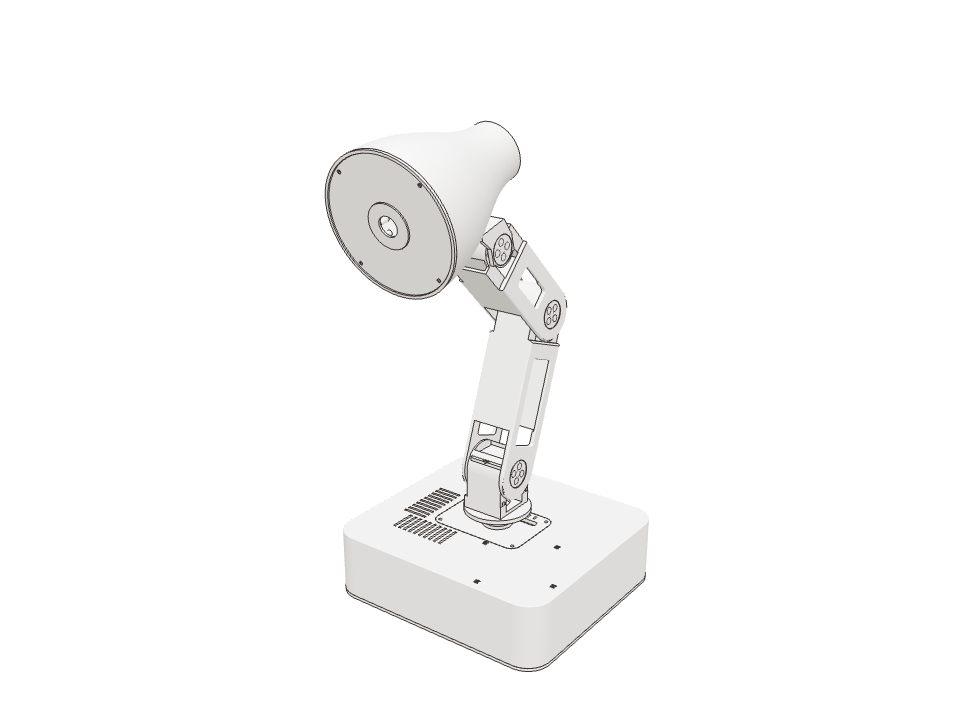
Orion is a home robot in the form of a desk lamp, built to assist and interact in a warm, playful, expressive way. Its onboard computer runs microphone processing, wake detection, speech recognition, speech synthesis and the motion runtime.
Overview
- Article
Redesigned body: a 200 × 230 mm base, straight two-piece arms with 150 mm and 131 mm spans, and a 125 mm head carrying the camera, speaker and LED ring.
First build on the open LeLamp reference design: servo-driven lamp arm, Raspberry Pi 5 and ReSpeaker microphones running the first voice and motion pipeline.
Log
Resources
Assembly guide
- Build Orion, step by stepEvery step with its screws, a 3D view of where the parts go, and why it's done that way.Open the guide
Bill of materials
Everything to buy for one lamp. Common parts such as cables, screws and inserts have no link: any shop that sells them will do. Printed parts are under CAD files below.
Electronics
- 1×Raspberry Pi 58GBBuy at The Pi Hut ↗
- 1×Active Cooler for Raspberry Pi 5Buy at The Pi Hut ↗
- 1×Serial Bus Servo Driver BoardBuy at The Pi Hut ↗
- 1×ReSpeaker XMOS XVF3800 4-mic arrayBuy at The Pi Hut ↗
- 1×Raspberry Pi Camera Module 3Wide-angleBuy at The Pi Hut ↗
- 1×Camera cable joiner / extender, 15-pin to 15-pinBuy at The Pi Hut ↗
- 1×Camera adapter cable for Raspberry Pi 5500 mmBuy at The Pi Hut ↗
- 1×Mono enclosed speaker, 3 W 4 ΩBuy at The Pi Hut ↗
- 1×NeoPixel Ring, 24 RGBW LEDsCool white 6000KBuy at The Pi Hut ↗
- 1×Feetech STS3215 serial bus servosPack of 6; Orion uses 5Buy at AliExpress ↗
- 1×Servo power supplyChoose 6 V 5 A, UK plugBuy at AliExpress ↗
Cables and power
- 1×Raspberry Pi 5 power supplyUSB-C, for the Pi only
- 1×Servo board power leadFrom the 6 V supply to the servo board
- 1×USB cable, servo board to Pi
- 1×USB cable, microphone array to PiThin cable (about 4.5 mm); it bends tightly inside the base
- 1×LED ring wires3 wires: 5 V, ground and data (GPIO12)
- 1×Speaker wires
- 2×Cable ties, 2.5 mm wideStrain relief for the two power leads
Screws, inserts and dowels
- 40×M3 heat-set inserts, 4 mm longBase shell 14, yaw carrier 4, rear panels 8, shoulder housing 6, head shell 8
- 20×M3 × 4 button-head screwsYaw horn adapter 4, shoulder horns 8, elbow horns 8
- 4×M3 × 5 button-head screwsNeck horn to the pitch fork
- 28×M3 × 6 button-head screwsBottom cover 6, tray 4, yaw retainer 4, shoulder 6, head cartridge 4, front cassette 4
- 20×M3 × 8 button-head screwsYaw carrier 4, rear panels 8, wrist horns 8
- 16×M3 × 20 screwsArm seams: lower arm 12, upper arm 4
- 8×Dowel pins, 3 mm × 6 mm4 per arm, to line up the two halves
- 10×M2 × 4 pan-head screwsCamera 4, LED ring retainer 3, microphone 3
- 24×M2 × 6 pan-head screwsElbow and wrist servos 12, yaw servo 4, servo board 4, neck servo retainer 4
- 2×M2 × 10 pan-head screwsShoulder servo
- 4×M2.5 × 4 screwsRaspberry Pi 5
- 4×M2.5 × 6 screwsSpeaker
- 3×M2 insulating washers, 0.5 mm thickUnder the microphone board screws
- 18×Thin removable adhesive tabs3 per decorative joint cap
CAD files
- Printable partsSTL · 26 files · Orion V2.1 · 5.6 MBEvery printed part of Orion V2.1, ready for your slicer. Print notes are in the README inside the zip.Download
Source code
- RepositoryThe project's code.View source ↗
Learn
How Orion works, one question at a time, with things you can watch, drag and try. No robotics background needed.
- 01Meet OrionWhat Orion is made of, what each part does, and the path one spoken sentence takes through the lamp.The parts inside the lampOne sentence, end to endWho moves the motorsWhat needs the internetStart →
- 02How does Orion move?How a named movement becomes smooth motion: five joints, poses and keyframes, curves instead of straight lines, and a loop that steers the motors 50 times a second. Every animation here runs Orion's own motion software in your browser.Joints and servosKeyframes and smooth curves50 times a secondMake your own motionStart →
- 03How does Orion see?From camera pixels to a turn of the head: finding faces and hands, keeping track of who's who, following a face or your hand, and what Orion's camera never does.Finding faces and handsFace trackingHand trackingCamera privacyStart →
- 04How does Orion hold conversations?From the sound of your voice to Orion's spoken reply: hearing its name, knowing when you've stopped, and where the waiting time goes.Sound as numbersHearing its nameKnowing when you've stoppedYour turn againStart →
- 05How does Orion become a character?The engineering behind a lamp that seems alive: animation principles, idles, a simple inner state, reactions timed to its voice, and knowing when to hold back.Animation principlesNever fully stillA simple inner stateCuriosity on a budgetStart →
- 06How does Orion decide to act?When Orion moves or speaks without being asked: one picture of the moment, how lively it is, the quirks every lamp is born with, the rules for speaking first, looking after you, and its memory of home.Quiet, Lively or DemoQuirksSpeaking firstA memory of homeStart →